

Pricing outlook
Price at Total Environment Yelahanka
Pricing is on request. This section explains the likely size bands, the questions to ask, and how to interpret the cost sheet when it is shared.
Size-wise guidance
Current price positioning
Likely entry-size option for buyers who want to stay within the project at a lower overall ticket.
Useful for buyers who want a larger home footprint and more flexibility in setbacks or parking.
Larger and irregular parcels that will usually depend more on position, frontage, and layout context.

Before you ask for the cost sheet
What to clarify before launch
Pricing is on request, so the useful exercise now is not guessing the number but knowing what to ask for. Ask which sizes are expected in the first release, whether corner or park-facing plots carry premiums, what the payment schedule looks like, and which cost-sheet version you are being shown. Plot Options and Master Plan help you read those numbers properly.
With plotted developments, the headline rate is only one part of the decision. Buyers should also check whether there are location-based premiums, club or infrastructure charges, legal or registration components, and whether the payment schedule is linked to a launch phase, milestones, or a shorter booking window.
It also helps to compare value at the parcel level, not just the size level. A smaller corner or park-facing plot can sometimes be more desirable than a larger internal plot, depending on the final road relationship and openness around it.
Size-wise availability: Ask which parcel bands are expected in the first release
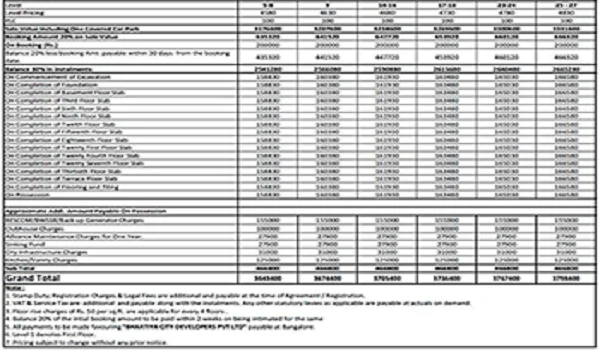
Cost sheet version: Request the latest copy rather than relying on forwarded screenshots or old dealer notes, then compare it with the planning cues in Master Plan
Payment structure: Clarify whether there are early-buyer benefits, launch offers, or phased payment timing
Premium loading: Understand how park-facing, corner, or larger parcels may be priced differently
How buyers usually read plotted pricing
Three parts of the cost conversation
Most pricing discussions become clearer when buyers separate the base parcel cost from the location premium and the payment structure.
This is the starting rate for the size band before location advantages or special positioning are added.
Corner, park-facing, larger-road, or better-buffer plots may be priced differently from standard internal parcels.
The schedule can change the decision as much as the number, especially for buyers deciding between booking now and waiting for a later phase.
That is why a cost sheet is most useful when read together with the plot plan and the community layout. Without that context, buyers often compare the wrong parcels or assume two plots have similar value when the actual site conditions are quite different.
A practical buyer usually asks for the latest cost sheet, confirms the release phase it applies to, and then checks whether the preferred parcel type is even part of that release. Doing those three things early removes much of the confusion that normally surrounds plotted pricing.
Need the latest update?
Need the latest official price update?
We can share the latest cost sheet, size-wise guidance, and launch communication as soon as it is released. That is usually the best way to avoid comparing outdated forwarded sheets or incomplete pricing notes.
Once you have the right version in hand, it becomes much easier to compare size bands and shortlist the parcel types worth tracking.